NADA RV values, hosted by J.D. Power, are the most trusted tool for determining what your RV is worth — whether you’re looking to sell, trade in, or make sure you’re properly insured. To find your RV’s value, enter your year, make, model, and options into the NADA guide to get a fair market price range. For the most accurate picture, compare that figure against current listings on platforms like RV Trader, and factor in your RV’s condition, mileage, and any upgrades. Understanding your RV’s value gives you real negotiating leverage and helps you avoid leaving money on the table.
Expert Insights From Blue Compass RV
According to RV dealership experts at Blue Compass RV, the two biggest factors affecting RV resale value are overall condition and age. Clean RVs with documented maintenance records typically hold value better than heavily modified units or RVs with signs of deferred maintenance.
Additional factors that can impact RV value include:
- Full-body paint condition
- Water damage
- Roof condition
- Tire age
- Factory-original features
- Diesel vs. gas engine type
How to Check Your RV’s Value
Here’s how to check your RV’s value so you know what your rig is worth. You’ll want to use trusted RV value guides like NADA. The NADA RV value guide, hosted by J.D. Power, is one of the most widely used pricing tools. Often referred to as the RV NADA Blue Book, this tool allows you to enter your RV’s year, make, model, and options to generate a fair market value range.
- Visit the J.D. Power RV Value Guide.
- Select your RV type (motorhome, travel trailer, etc.).
- Enter your make, model, and year.
- Adjust for mileage, upgrades, or optional equipment.
- Review both low retail and average retail values to estimate your range.
Low retail is closer to wholesale/trade-in pricing, but actual trade-ins are usually lower.
Check Comparable Listings Online
After getting a baseline from NADA, visit online RV marketplaces to see what similar rigs are actually selling for. Sites like RVTrader, RVT, and Facebook Marketplace let you search by make, model, and location to find real-world pricing data.
This step helps you compare asking prices versus valuation guides, which can vary depending on demand, upgrades, and condition.
Talk to a Local Dealer or Appraiser
If you’re planning to trade in or sell soon, consider getting a professional appraisal. Dealers can provide on-the-spot value estimates based on current demand and inventory trends. While they might quote slightly below retail (to allow for resale margin), it’s still valuable insight into your RV’s true market position.
Factor in Condition and Upgrades
Even small details can make a big difference in price. Regular maintenance, low mileage, and upgrades like solar panels or modern interiors can boost value. Conversely, water damage, outdated appliances, or high mileage can lower it. Always be honest about your RV’s condition — accuracy helps you attract serious buyers and fair offers.
What Are RV Values (and Why Do They Matter)?
Understanding RV values helps you make smarter financial decisions. An RV’s value represents what it’s worth on the current market, similar to a car’s Blue Book value. It’s based on factors like age, condition, mileage, brand reputation, and even the time of year.
There are generally three types of RV values to know:
- Trade-in value: What a dealer might offer if you trade your RV for another one.
- Private sale value: The price you could expect if selling directly to another buyer.
- Retail value: What a dealership might list the same RV for on their lot.
Knowing these values gives you leverage for negotiating with a dealer, setting a fair sale price, or ensuring your insurance coverage matches your RV’s true worth. By understanding how RV values are determined, you can avoid underselling, overpaying, or misjudging what your RV is really worth in today’s market.
What Are the Different Ways to Get an RV Valuation?
If you’ve ever looked up the value of vehicles, you probably used Kelley Blue Book values. However, Kelley Blue Book does not provide official RV pricing. Options for RV valuations include NADA, RV Trader, and calculating based on what you find on sites such as Craigslist and National Vehicle.
National Automobile Dealers’ Association (NADA)
NADA, or the National Automobile Dealers’ Association, provides values for used RVs. They list prices and values for motorhomes, travel trailers, and even truck campers and park models. They’re the closest option to a Kelley Blue Book for RVs.
RV Trader
Platforms like RV Trader, which help people buy and sell RVs, are also a great resource for getting an approximate value of your rig. Check out their price checker tool as a great starting point.
DIY RV Value
You can also search other buying and selling websites like Craigslist, National Vehicle, or local RV dealerships.
What RV Dealers Look for When Determining RV Value
Overall condition and age.
A clean, well-cared-for RV with updated maintenance records will always hold value better, regardless of mileage or features.
Mistakes that could hurt RV value.
Customizations are one of the fastest ways to hurt RV resale value. Most buyers prefer factory-original layouts and features, so any customization can limit buyer interest and reduce value. Lack of maintenance is another major issue, especially when it leads to water damage, worn tires, or mechanical problems.
How the RV type and brand hold value.
Diesel units typically retain value better than gas models, especially tag axles. RVs with full-body paint also tend to hold value better because they age more attractively. Class C motorhomes continue to remain popular and generally have strong resale demand.
If the RV is well-maintained.
Recently resealed roofs and body seams are a major indicator of good upkeep because they help prevent costly water damage. Tires that are under five years old also show the owner has stayed on top of maintenance and safety.
What Determines Your RV’s Worth?
When it comes to determining an RV’s or camper’s value, there are a lot of variables that go into the baseline figure. Here are a few factors to keep in mind:
- The make, model, and year of the vehicle. Certain brand names, like Airstream, are known to hold their value better.
- Newer, higher-rated models will generally command a higher price than older, lower-rated ones.
- Vehicle size – larger RVs are typically valued higher than smaller ones.
- The mileage – low mileage is preferable to high mileage.
- The condition of the engine, transmission, and other parts which are crucial to driving an RV.
- The configuration and overall condition of the RV’s interior.
- The number and types of extras that are included with the vehicle.
Consider investing in a certified RV appraisal for enhanced leverage when selling. Certified appraisers use industry pricing databases, comparable sales, and condition inspections. Appraisal costs typically start around $100 in most states.

More on RV Value
How Much Does an RV Depreciate?
Like other vehicles, RVs don’t appreciate in value.
New RV values take a pretty big hit the moment they’re driven off the lot. The depreciation continues for the life of the RV. If you’re buying a used RV, this means that you can expect to pay less than you would for a new one. But if you’re selling, it’s important to realize that you won’t get anything close to what you paid for your RV when it was new. RV resale values are typically on the low side. Sprucing up the interior and making sure the mechanics are in good working order will improve the value. But ultimately, you need to be realistic about the value of used RVs.
The extent to which travel trailers, campers, and RVs depreciate varies based on how many miles the RV has been driven, the condition of its systems and interior, and the type of rig. Certain RVs like Prevosts and Airstreams tend to maintain their value well over time. However, an entry-level Coachman may depreciate more quickly.
There are two ways to discuss the worth of your RV going down.
- Diminished value, or loss of value: The diminished value is the difference between your RV’s market value before something like an accident or other damage, and its value once it has been repaired after an accident or damage.
- Depreciation: Depreciation is the RV’s loss of its value over time, caused by normal wear and tear on the vehicle. Things like your RV’s mileage and age cause depreciation of the vehicle.
Loss of value happens suddenly and is unpredictable. Depreciation happens gradually over time and can be calculated and accounted for each year.
What Does RV Depreciation Look Like Over Time?
Many RVs lose 20–30% in the first few years, but depreciation varies widely.
There’s no one easy way to figure out how much your RV will depreciate in a given amount of time. The best course of action is to use the steps above to find an approximation of your RV’s value.

This chart demonstrates how the depreciation of an RV slows down over time, with the highest percentage lost typically occurring in the first year and gradually decreasing in subsequent years.
RV Resale Value FAQs
What factors affect RV resale value the most?
The biggest factors affecting RV resale value are overall condition and age. According to Blue Compass RV, well-maintained RVs with clean interiors, updated service records, and minimal wear typically retain value better than heavily customized or poorly maintained models.
What hurts RV resale value the fastest?
Customizations and deferred maintenance can reduce RV resale value quickly. Industry experts at Blue Compass RV note that buyers often prefer factory-original layouts and features, while issues like water damage, worn tires, and neglected repairs can significantly lower buyer interest.
Which RVs hold their value best?
Diesel RVs, especially tag axle models, often retain value better than gas motorhomes. RVs with full-body paint and Class C motorhomes also tend to perform well in the resale market due to continued buyer demand.
Campers vs. RVs: Does Value Change Based on Toppers, Towables, and Driveables?
Yes, the value of campers and RVs can vary significantly depending on whether they’re toppers, towables, or drivables. The value is shaped by factors like use case, convenience, and resale potential.
- Toppers (like truck campers) tend to be the most affordable and versatile option. They’re lightweight, detachable, and great for weekend trips or off-grid adventures. However, their resale value depends heavily on the condition of the camper.
- Towables (travel trailers, fifth wheels, teardrops) come in a wide range of prices and features, from budget-friendly basics to luxury models. Their value can depend on tow vehicle compatibility and whether they offer features like slide-outs, bathrooms, or off-road capability. Since you’re not putting miles on the camper itself, towables tend to hold value better over time.
- Driveables (Motorhomes, Class A, B, and C RVs) are generally the most expensive upfront, but they combine transportation and living space. Their value is impacted by mileage, maintenance, and engine condition. While they offer unmatched convenience, especially for long trips, they can depreciate faster than towables because of wear and tear on the drivetrain.
How Do I Sell My Used RV?
Once you see your RV’s retail or trade-in value, you may still wonder how to sell it. Just as with selling a vehicle, you have a couple of different options: you can sell your RV on the private market, trade it in at a dealership, or sell it on consignment.
There are pluses and minuses to all of these approaches. A dealership might not net you as much money as a private sale, but it’s usually an easier and quicker process. Keep in mind that you’ll have to find a dealer who’s willing to sell your make and model; some are interested only in their home brand.
A private sale could take longer, especially if there aren’t many buyers in your area, or buyers aren’t looking for your make and model.
If you’re making a private sale, always make sure you ask the buyer for cash, cashier’s check, or money order. Accepting checks is dangerous when that much money is at stake.
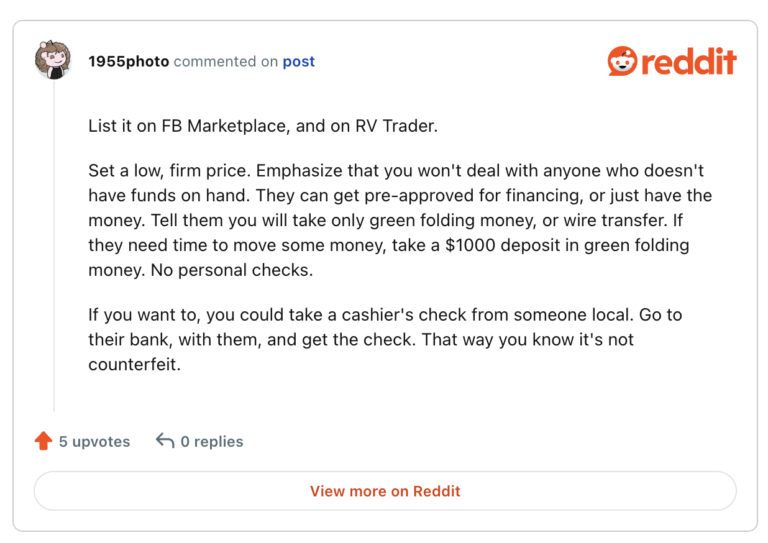
You’ll also want to go through all the required paperwork to ensure the state knows the RV is no longer yours and you’re no longer liable for it. Generally, you need to file a bill of sale and title transfer with the DMV. 1955photo from Reddit recommends Facebook Marketplace or RV Trader:
Market Trends
According to Blue Compass RV insiders, while the surge in demand seen during and after COVID has normalized, interest in camping and RV travel remains strong. Younger consumers are increasingly exploring the RV lifestyle through rentals, short-term experiences, and alternative accommodations before transitioning into ownership. This shift reflects a broader trend toward flexible travel experiences while continuing to introduce new audiences to camping and the RV lifestyle.
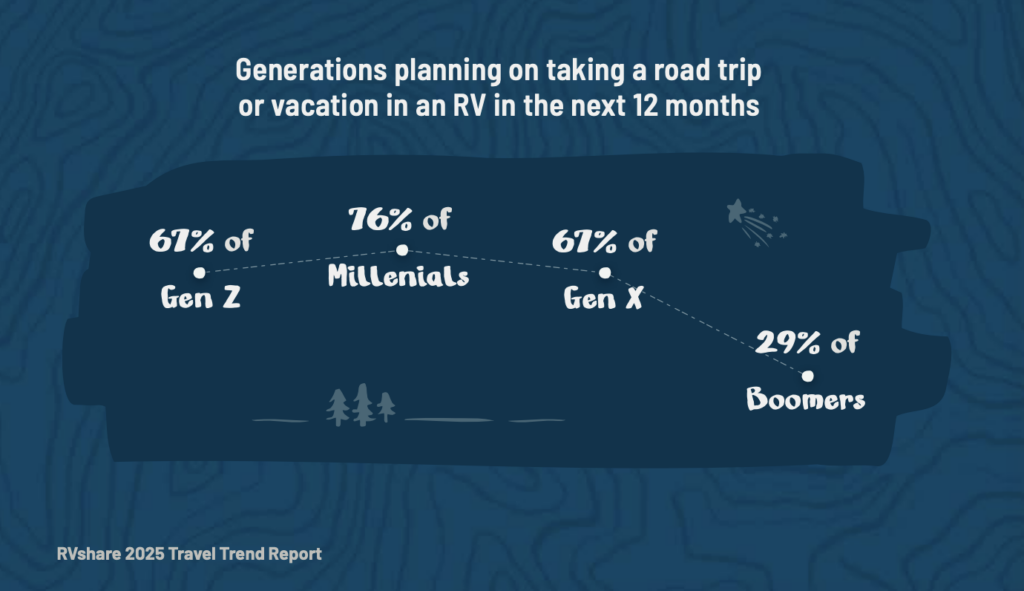
RVshare’s data also reflects a younger generation turning toward the RV lifestyle. According to our 2025 Travel Trend Report, RV trips continue to be popular among Millennials and Gen Z, and have returned in popularity among Gen X travelers, with a 12-percentage-point increase.
Best Ways to Maximize Your RV Value
Here are tips to maximize your RV value when you’re trying to sell it.
RV Values Change With the Seasons
Unlike cars, RV values are often dependent on what time of year you’re looking to buy or sell. Summer is typically RV season, so values tend to be higher in the spring when potential buyers have camping vacations on their minds. If you go to sell your RV in the fall when the camping season has slowed, you may find that the resale value takes a dip.
Clean Up Trouble Spots
To keep your RV value high, you’ll want to eliminate signs of major damage or disrepair before selling. Try to look at it from the perspective of a potential buyer. Aesthetics are important, especially since certain things can signal bigger problems. Water stains don’t look good, but more importantly, they can indicate a leak or hidden mold.
Good Condition Goes a Long Way
An RV is meant to be lived in, but if yours looks worn, it will take a hit in value. Beat up and outdated upholstery, noticeable cosmetic issues, old appliances that show their age, and obvious wear and tear can lower your RV resale value. Dents and dings on the exterior will also bring down RV value. You’ll want to fix up any interior or exterior damage and make sure appliances are in good working order. Otherwise, you can expect potential buyers to use these issues as bargaining chips to get you to come down on price.
Stage Well to Improve Perceived Value
Think of selling your RV as comparable to selling your home. You don’t just want to make it look presentable — you want to make it look great! Clear out the clutter, clean up everything, and make it look ready to live in immediately. If a buyer thinks he or she doesn’t have to do anything to use the RV except hand over money, you’ll probably improve your RV value, and you might be able to ask for more money.
NADA RV Values Glossary of Terms
- Suggested List Price (MSRP): The sticker price or manufacturer’s suggested retail price (MSRP) for new RVs at dealerships. It serves as a starting point for negotiations, though actual purchase prices often differ based on market conditions.
- Low Retail Price (Dealer Trade): The price typically paid at dealerships for used RVs in below-average condition or with high mileage. It also represents the maximum amount most dealers will offer for a trade-in.
- Average Retail Price (Retail Value): The price expected when purchasing a used RV from a dealership, serving as a baseline for negotiations within a specific geographic area. Prices can vary among dealers based on RV condition and valuation methods.
- Private Party Value: A term used by Kelley Blue Book to denote the initial value private sellers can use as a starting point for negotiating the price of a used vehicle. Not directly used by NADA Guide.
- Wholesale Value: The amount dealers receive when selling an RV at an auction or the cash offered if the dealer buys the RV outright. NADA Guide’s wholesale pricing is not publicly accessible, but a rough estimate can be derived by subtracting 10% to 20% from the low retail price.
- Depreciation: The reduction in RV value over time, similar to cars and trucks. RVs typically depreciate by 10% to 20% in the first year and continue to lose value, with an average depreciation of 36% to 38% after five years. Factors influencing NADA Guides value calculation also affect depreciation rates.
- NADA Blue Book Value: “Book value” or “Blue Book value” is a generic term used to determine the actual worth of RVs and passenger vehicles. Initially coined by Kelley Blue Book, it has become widely adopted as the standard term for automotive appraisals.
Key Takeaways
- To determine your RV’s worth, use trusted sources like NADA RV values and J.D. Power RV Value Guide.
- Check comparable listings online to see real-world selling prices against valuation guides.
- Factor in your RV’s condition and upgrades, as they can significantly influence its resale value.
- Understand the types of RV values: trade-in, private sale, and retail, to negotiate better deals.
- Maximize your RV value by cleaning, maintaining good condition, and timing your sale around seasonal demand.
FAQS About RV Values
A: NADA RV values are generally a solid starting point for estimating what your RV is worth. They’re based on market data, manufacturer information, and sales trends. However, they don’t always reflect real-time market conditions, regional demand, or unique upgrades, so it’s smart to also compare listings for similar RVs on platforms like RV Trader.
A: You can start by checking the NADA Guides website for your RV’s make, model, year, and condition. Then, compare that figure with current listings for similar RVs in your area. Factoring in mileage, features, and the season will give you the most accurate estimate.
A: RV values tend to depreciate over time, and factors like age, wear and tear, maintenance history, and market demand can lower the price. If demand is slow or newer models with more features have entered the market, your RV’s value may drop faster than expected.
A: Upgrades like solar panels, new appliances, or updated interiors can boost appeal and resale value, especially if they improve comfort or efficiency. However, highly personalized modifications (like bold décor or niche layouts) can make your RV less appealing to a broad audience and may not add much monetary value.
First, visit the J.D. Power RV Value Guide. Select your RV type (motorhome, travel trailer, etc.) and enter your make, model, and year. Adjust for mileage, upgrades, or optional equipment.
After navigating to the J.D. Power RV Value Guide and inputting your RV type/make/model/year, review both low retail and average retail values to estimate your range.
Want to earn money on your RV without selling it?
If you’re thinking about putting your RV on the market because of the expense, there might be a better option.
Listing your RV on RVshare is a great way to put your rig to work for you when it would otherwise be sitting empty.
Using our peer-to-peer RV rental marketplace platform is simple. Create a high-quality listing complete with details and pictures of your rig. Customize your preferences and options, and RVshare will take care of the marketing. You’re in control of who rents your RV and how long they rent it for, and our rating and verification systems add an extra layer of security.