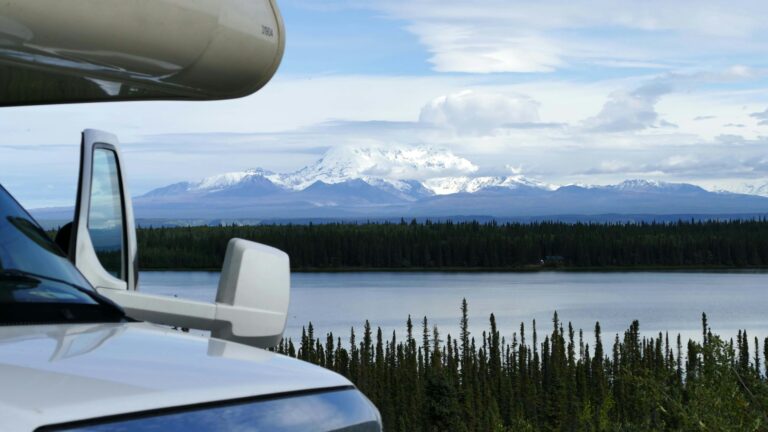
Full-time RV living in Oregon is legal as long as you abide by state and local laws. The state offers hundreds of thousands of acres of State Trust Land for boondocking, where you can camp for up to 30 days before relocating. Oregon requires RV insurance, including bodily injury and property damage liability, personal injury protection, and uninsured/underinsured motorist coverage, while trailer towing laws limit trailers to 40 feet and the combined vehicle/trailer length to a maximum of 65 feet. They must also have safety chains and working lights, and there is a 55 mph speed limit in most areas. RV parking laws vary significantly by city, so it’s helpful to know the requirements before staying in a particular area. Oregon’s January 2024 law changes extended RV park tenancy status from 45 to 90 days and allowed homeowners to keep occupied RVs on their property, though costs typically range $400 to 800 a month at long-term RV parks with some offering annual discounts, making Oregon an attractive option for full-time RVers who want access to stunning coastlines, waterfalls, state forests, and the flexibility of 30-day boondocking on public trust lands.
Oregon RV Living: Legal and Illegal Locations At a Glance
| Location Type | Legal Status | Typical Cost | Duration Limit | Best For |
| Long-Term RV Parks | Legal | $400-800/month | Monthly/annual rates | Most practical option |
| Own Property (With Authorization) | Legal | Land cost + permits | Varies by county | Property owners with permits |
| Own Property (No Authorization) | Illegal | N/A | Not allowed | Illegal – don’t attempt |
| State Trust Land (Boondocking) | Legal | Free | 30 days per location | Boondockers, budget travelers |
| Portland Private Property | Prohibited | N/A | RV parks only | Not an option in Portland |
| Eugene Private Property | Restricted | County authorization required | With permit | Requires county approval |
| State Forest Campgrounds | Legal | Campground fees | Varies by location | Nature lovers, established sites |
| Rural Areas (Private Property) | Generally Flexible | Varies | Check local ordinances | Rural property owners |
| City Streets (Temporary) | Restricted | Free | 1-2 days typical | Emergency parking only |
Why Full-Time RV Living Laws Matter in Oregon in 2026
Oregon has relatively flexible RV living laws compared to many states, but understanding local variations is crucial since regulations differ significantly from city to city. While the state broadly allows RV living, your experience will vary dramatically depending on whether you’re in Portland, where it’s more restrictive, or rural areas, which are more permissive.
Where Can You Legally Park an RV Long-Term in Oregon?
You can legally park an RV long-term in Oregon at long-term RV parks, which is the most practical option, on State Trust Land for up to 30 days before relocating, in state forest campgrounds following posted rules, on your own property if you receive proper authorization from local authorities, or in rural areas where ordinances are typically more flexible than in urban locations.
RV parking laws vary from city to city. Most places in Oregon allow you to park an RV in a driveway or side yard. However, not all places allow you to keep your RV on your premises indefinitely. Many places allow you to park your camper on the street temporarily for a day or two, but this is for short-term parking only, not for long-term living. RV parking laws are often more flexible in rural areas where property sizes are larger, and neighbors are farther apart.
What Types of Properties Can You Live on Full Time in an RV in Oregon?
Here are the kinds of properties you can live in when you’re home is an RV.
- Your own property: You can live in an RV on your own property if you receive authorization to do so. You can also reside in an RV on your premises if your home has been seriously damaged by a disaster.
- Long-term campgrounds: The easiest way to engage in RV living full time in Oregon is to stay at an RV park. Many of these RV-friendly facilities offer long-term or even annual rates.
Where Can You Boondock or Camp for Free in Oregon?
Oregon is home to thousands of acres of State Trust Land; you can go boondocking in any area that has an accessible road nearby and no gates or signs telling you not to camp. You can camp for up to 30 days before having to relocate. Don’t forget to properly dispose of all trash, and don’t go through private property without permission. Some great boondocking locations in Oregon include Huckleberry City, Hult Pond, and the Mayfield Pond Recreation Area.
What Are the Rules for Camping on Public Land in Oregon?
Some great public lands that are ideal for camping are Oregon’s state forest campgrounds. Whether you want to stay at an established campground, a designated campsite, or a dispersed camping area, you’ll have no problem finding the perfect spot. The rules for camping in Oregon’s state forests include camping at least 25 feet from a river or stream, packing out all garbage if there are no trash cans, and keeping all pets on six-foot leashes.
What Are Oregon’s RV Insurance Requirements?
RV insurance requirements in Oregon are similar to those of cars. You’ll need to have bodily injury and property damage liability coverage, personal injury protection, and uninsured/underinsured motorist bodily injury coverage. If you have a travel trailer, you aren’t required to have special insurance for it because it’s covered under the towing vehicle’s policy. You’re not required to procure comprehensive and collision coverage, but doing so would be a wise investment.
Another option that’s not strictly necessary but can be useful is full-time RV insurance. This type of coverage provides additional financial protection against liability for accidents that may occur while your RV is parked.
What Are Oregon’s Trailer Towing Laws?
Towing your trailer correctly requires you to abide by multiple rules and regulations. Your trailer can only be up to 40 feet long. The combined length of your camper and vehicle can’t be greater than 65 feet. All trailers must be attached to towing vehicles with safety cables or chains. They also need to have turn signals, taillights, and brake lights. Most areas in Oregon require that you not exceed 55 miles per hour while towing a camper.
Full Time RVing in Portland
Portland is Oregon’s biggest city, so it’s full of interesting attractions like the Oregon Zoo and the Portland Japanese Garden. The simplest way to experience RV living full time in Portland is to stay at one of the multiple long-term RV campgrounds in the area.
RVing in Portland FAQs
You can park your RV in a driveway or backyard. You can’t park your camper between your house and the street.
RVs aren’t considered dwelling units in Portland, so you can’t live in them permanently on your property. The only way you can legally live in your RV in Portland is in an RV park.
Full Time RVing in Eugene
Eugene is home to the University of Oregon, the Owen Rose Garden, and a stretch of the Willamette River. Several RV campgrounds in the area allow guests to stay on a long-term basis.
RVing in Eugene FAQs
You can’t park your camper in front of a home or hotel for more than three nights within a 90-day period. Some parking spaces in Eugene have two-hour limits on them, so RVs can only park in them temporarily.
You must have authorization from the county to live in an RV on privately owned residential property. The only other situations in which you can live in your RV are in an RV park or if your home has become uninhabitable due to a disaster.
How Do You Establish Your Oregon RV Domicile?
Can you live in an RV full time in Oregon? Yes, as long as you make sure to take care of the necessary logistics and finances. You may need to get a flexible mobile job that will enable you to work online. You’ll need to make sure that you have enough money to pay for insurance, phone, internet, RV maintenance, and more.
You’ll also need to ensure that you can receive your mail. Perhaps you could get a family member or friend to handle your mail for you. Maybe you could set up a forwarding service. Another option would be to have your mail delivered to a nearby post office. If you’re staying at an RV park, then you might be able to receive your mail there.
Another important aspect of full-time RV living is establishing residency. Doing so is necessary to file taxes, obtain healthcare, register your car, and vote. In order to establish residency, you’ll need to obtain an address, get a driver’s license, and file all appropriate legal documents.
Key Takeaways
- Living in an RV in Oregon is legal if you follow state and local laws, including insurance and towing regulations.
- Boondocking is allowed for up to 30 days on State Trust Land, while long-term RV parks charge $400 to $800 per month.
- Portland has stricter RV laws, allowing RVs only in designated parks, while rural areas tend to be more flexible for parking.
- Oregon’s new law in January 2024 extends RV park tenancy from 45 to 90 days and permits occupied RVs on private properties.
- Understanding local regulations is crucial as they can vary significantly between cities and rural areas.
RVing in Oregon FAQs
If you’re driving your RV across the US, then you’ll need to find safe places to sleep while on the road. One obvious option is to camp at national parks, state parks, or BLM areas. Another option is to park overnight at a Walmart, Cracker Barrel, Camping World, or Cabelas; many of these big-box retailers allow travelers to spend the night. Other RV parking possibilities are truck stops, church parking lots, and casinos.
As of January 1, 2024, a new Oregon RV law states that those living in RV parks become tenants after 90 days of habitation rather than the previous standard of 45 days. This new law also states that RV park owners can evict RVers after a 90-day period without cause as long as they give RV owners a 14-day notice.
Yes, you can live in an RV full time as long as you abide by local laws, aren’t disruptive, and don’t damage property.
Thanks to another new law that went into effect on January 1, 2024, homeowners can keep an occupied RV on the property. Be sure to look into local rules and regulations before you park your camper since laws can vary by city.
One way to make sure you’re abiding by local laws is to buy an RV lot that’s set up with RVing in mind. Many property sizes and price points are available, so you’ll be able to find the property that’s right for you.
There are plenty of RV parks in Oregon that offer monthly or even yearly camping options. Many of these RV parks will allow you to stay at them indefinitely; some even offer a discount for renting annually instead of monthly.
Oregon is a stunning state with plenty of outstanding locations to take an RV, including some fantastic scenic drives. Before you embark on your journey, remember that buying and maintaining an RV can be expensive, so consider renting one first. If you rent an RV rather than buy one, you’ll be able to learn how to live in an RV in Oregon without having to commit to owning your own camper right away.