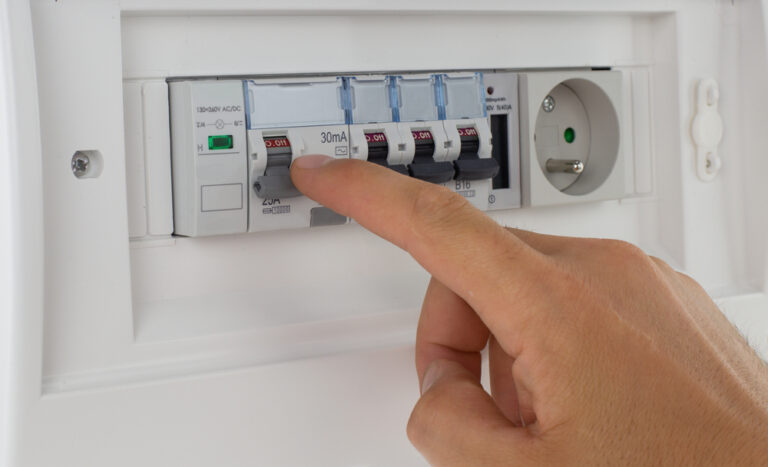
The circuit breaker panel in most RVs is located inside the living area on a wall near the floor, commonly found under the refrigerator, beneath the bed, inside a cabinet near the entry door, or under a pantry. Some motorhomes place the breaker panel in exterior storage bays. The panel is typically covered by a plastic piece and contains both circuit breakers for AC power and fuses for 12-volt DC systems, making it essential to locate before your first trip for quick troubleshooting when electrical issues arise.
RV Circuit Breaker Panel Locations At a Glance
| Location | RV Type | Accessibility | Common In |
| Under refrigerator | Travel trailers, fifth wheels | Easy access, living area | Most common location |
| Inside cabinet/pantry | All types | Hidden, may need to open doors | Design-focused RVs |
| Under bed | Class C, fifth wheels | Requires lifting mattress | Bedroom slide models |
| Near entry door | Travel trailers, Class C | Very accessible | Newer RVs |
| Exterior storage bay | Class A motorhomes | Outside access only | Larger motorhomes |
| Under dinette bench | Travel trailers | Requires lifting cushions | Compact layouts |
Why Knowing Your Circuit Breaker Location Matters
Finding your RV circuit breaker panel before electrical problems occur can save you time and frustration. It keeps you from searching for it in the dark with a flashlight during a power outage. Knowing where the breaker is means you can quickly restore power to essential appliances like the refrigerator and air conditioner. You can easily identify which specific circuit has tripped and fix it. You can also perform routine checks and maintenance on your electrical system.
The main circuit breaker controls all power to your RV. When it trips, you lose everything electrical. Individual breakers control specific circuits, so tripping one affects only certain outlets or appliances.
How Do I Find My RV Circuit Breaker Panel?
In order to find your circuit breaker, you need to locate your RV fuse panel. Start your search in the most common locations. The breaker panel needs to be accessible, but typically won’t stand out against your RV’s interior decor. Look for a rectangular plastic cover, usually white or beige, measuring approximately 8-12 inches wide. If you can’t locate it after checking common spots, consult your RV owner’s manual or contact the manufacturer. Some RVs, especially Class A motorhomes, place panels in exterior storage compartments, which can be harder to find but protect interior living space.
It’s a good idea to locate your panel before even leaving on an RV trip, just so you know where it is.
Once you do have your RV fuse panel location, you should be able to locate a flipped breaker switch by feeling for the loose switch and flipping it back on.
What is an RV Circuit Breaker?
Understanding what a circuit breaker is might help you diagnose your problem. An RV circuit breaker is a safety device that automatically interrupts power supply when electrical current exceeds safe levels, protecting against electrical shock, fire, and damage to your RV’s electrical system.
Circuit breakers work by detecting overloads or short circuits and “tripping” to cut power to that circuit. Unlike fuses that blow once and must be replaced, breakers can be reset by flipping the switch back to the “on” position. This reusable design makes breakers more convenient for RVers who frequently use multiple appliances.
Most RV breaker panels contain both AC circuit breakers for 120-volt shore power and DC fuses for 12-volt battery power, so you have control over your entire electrical system in one location.
How do I Reset My RV Breaker?
To reset your RV breaker, find the breaker panel and then the tripped breaker (usually a loose-feeling switch or switch in the middle position), and flip it fully “off,” then back “on” to reset it.
Some breakers show a small red or orange indicator when tripped. If the breaker trips immediately after resetting, you likely have an overloaded circuit or a short circuit that needs addressing before you can use that circuit again.
Why Does My RV Have No Power When the Breaker Isn’t Tripped?
If the power to your RV goes out suddenly but the RV breaker isn’t tripped, there are a few different things that could be wrong.
Some of the more common issues are:
- Tripped breaker at the pole — Sometimes the breaker at the electric pole will trip before the RV breaker does. Be sure to check this out if flipping your RV breaker doesn’t do the trick.
- Power outage — Power outages happen everywhere. There’s a chance your campground is simply experiencing a power outage. This is especially likely if a storm is passing through your area when you lose electricity.
- Problem with the power cord — Sometimes, wires inside an RV power cord will melt or break. If this happens to your cord, it will cease to deliver electricity to your rig, causing a power outage. In most cases, you can unplug the cord. Cut the head and broken part off your cord with wire cutters, and replace just the head to fix the issue.
Why Does My RV Circuit Breaker Keep Tripping?
Does your RV circuit breaker keep tripping no matter how many times you flip it back? If this is the case, there are a few things that could be causing the problem:
- Overloaded circuit — Try using fewer appliances and lights to see if this solves the problem. If so, you might just be overloading the system. The air conditioner and microwave are good places to start, as they tend to use the most power.
- Appliance short circuit — If you suspect this is the case, stop using all appliances and locate and fix the problem right away.
- Bad breaker — A bad breaker will trip repeatedly for no apparent reason. If this is the issue, you will need to replace the breaker with an identical one. Doing this can be dangerous, so be sure you are disconnected from shore power, not running a generator, and that any automatic inverters are shut off. If you feel unsure about this process, hire a professional.
Key Takeaways
- The RV fuse panel location is typically inside the living area, often found near the refrigerator, under the bed, or inside a cabinet.
- Finding the RV fuse panel before a trip helps you troubleshoot electrical issues quickly and efficiently.
- Common signs of a tripped breaker include loss of power or a switch that feels loose or is in the middle position.
- Circuit breakers reset automatically, while fuses need replacement after blowing, providing more convenience for RV users.
- To reset a tripped breaker, flip the switch fully off and then back on; check for overloaded circuits if the breaker continues to trip.
FAQs About RV Circuit Breakers
In most RVs, the circuit breaker panel is located inside the living area, often under the refrigerator, beneath the bed, inside a cabinet, or near the entry door. It’s usually combined with the 12-volt fuse panel for easy access to both AC and DC systems.
Your first sign is likely to be a loss of power: you plug something in but it doesn’t work or the lights go out. However, the breakers themselves may also have a small red or orange flag that shows they’ve tripped, or be in the middle or “off” position rather than on.
RV breaker boxes are specifically built to be hidden. After all, most people don’t want to look at them all day! Check inside cabinets, under the refrigerator, or even below your bed. You can also consult the owner’s manual or manufacturer’s website if you still can’t find it.
RV circuit breakers reset after tripping, protecting circuits from overload or short-circuiting. Fuses blow once when current exceeds limits and must be replaced. Breakers are reusable and convenient, while fuses are simpler, cheaper, and faster to install but less flexible for repeated trips.
Yes, you can, but because electricity can be dangerous, it’s always worth hiring a professional if you have any doubts. If you do replace your RV’s circuit breaker yourself, be sure to start by disconnecting from shore power and only replace like-for-like breakers of the same amperage.
Finding your RV circuit breaker panel and understanding how to troubleshoot common electrical issues keeps your camping trips running smoothly. Take time before your next adventure to locate your panel, identify individual circuits, and practice resetting breakers, so you’re ready when electrical problems arise.