The drive from Flagstaff to Grand Canyon National Park’s South Rim is about 80 miles and takes roughly 1.5 hours on US-180. Flagstaff makes an ideal RV base: you can fly in, pick up your rental, and stock up on groceries, fuel, and propane before heading north. Travelers in big rigs or towing trailers should take the wider I-40 West to Williams, then AZ-64 North, which adds about 10 miles. The Williams route is also the safer choice from November through March, when snow and ice hit US-180.
What are the driving routes from Flagstaff to the Grand Canyon?
| Route | Distance | Time | Best for |
| US-180 → Valle → AZ-64 North | ~80 miles | ~1.5 hours | Cars, camper vans, and smaller motorhomes in good weather; the shortest route, but two-lane and snow-prone |
| I-40 West → Williams → AZ-64 North | ~90 miles | ~1.5–1.75 hours | Class A motorhomes, fifth wheels, travel trailers, and anyone driving November through March |
| US-89 North → Cameron → AZ-64 West (East Entrance) | ~105 miles | ~2–2.25 hours | Scenic loops and return legs; enters at Desert View with Little Colorado River Gorge views |
How far is Flagstaff from the Grand Canyon?
Flagstaff is about 80 miles from the Grand Canyon’s South Rim, or roughly 1.5 hours of driving on US-180. The National Park Service lists the distance as 81 miles. That puts Flagstaff closer to the rim than Sedona, Phoenix, or Las Vegas, and it’s the largest city in the region.
Flagstaff sits at about 7,000 feet, roughly the same elevation as the South Rim, so you won’t face a long climb once you leave town. The South Rim is open year-round.
Going the other way, Grand Canyon to Flagstaff covers the same mileage. If you fly into Grand Canyon National Park Airport in Tusayan, Flagstaff is about 75 miles southeast.
How long is the drive, really?
Plan on 1.5 hours of drive time, but a large RV may go slower. In summer, the line at the South Entrance gate can also add time, especially late morning. Once inside, it’s about 6 more miles to Grand Canyon Village, Mather Campground, and Trailer Village.
With an early start and little entrance traffic, you may reach your campsite in roughly two hours. But at busy times, the wait at the gate can add up to two hours.
When to leave Flagstaff to beat the gate line
Leave Flagstaff by 7 or 8 a.m. That gets you to the South Entrance before the late-morning rush and leaves daylight for setup at camp. Buying your park pass online ahead of time also speeds things up at the gate.
From July through September, an early start keeps you ahead of the afternoon monsoon storms common in northern Arizona.
What’s the best route from Flagstaff to the Grand Canyon?
The best route from Flagstaff to the Grand Canyon by RV is I-40 West to Williams, then AZ-64 North to the South Entrance. It’s about 10 miles longer than US-180, but you’ll be on the interstate for the first 30 miles and you avoid US-180’s winter trouble spots. In a car or small motorhome in good weather, US-180 is the faster pick.
For more route options into the park, see our guide to Sedona to Grand Canyon.
US-180 direct: the short, scenic two-lane
US-180 heads northwest out of Flagstaff, skirts the San Francisco Peaks, and winds through the ponderosa pines of the Coconino National Forest. At Valle, it meets AZ-64 for the final 30 miles north to the South Entrance.
It’s the shortest route at about 80 miles, and it’s a beautiful drive. But it’s a two-lane mountain highway with limited passing, and it’s the most weather-exposed of the three routes. From November through March, snow and ice can close stretches north of the Arizona Snowbowl turnoff. On winter weekends after a storm, traffic can also back up for miles near Flagstaff as people head to play in the snow.
Take US-180 if you’re in a car, camper van, or smaller motorhome, and the forecast is clear.
I-40 West to Williams, then AZ-64: the trailer-friendly route
From Flagstaff, take I-40 West about 30 miles to Exit 165, just east of Williams. Then follow AZ-64 North about 60 miles to the South Entrance.
The interstate segment is four lanes with gentle grades. AZ-64 is a two-lane highway, but it runs fairly straight across open high-desert plateau, without US-180’s forest curves. ADOT also points Grand Canyon traffic to this route when US-180 is restricted.
Take this route in a Class A motorhome, a long fifth wheel, or any towable, and if you’re traveling November through March. You can also visit Williams along this route, home of the Grand Canyon Railway and a classic Route 66 downtown. Check az511.gov for road conditions before you go.
The East Entrance via Cameron (US-89 to AZ-64)
This route heads north on US-89 for about 53 miles to Cameron, home of the historic Cameron Trading Post. From there, AZ-64 runs west about 30 miles to the park’s East Entrance at Desert View. Along the way, you’ll pass pull-offs overlooking the Little Colorado River Gorge on Navajo Nation land.
Inside the park, it’s another 25 miles along Desert View Drive to Grand Canyon Village, with canyon viewpoints the whole way. The Desert View Watchtower is right at the entrance.
At about 105 miles, it’s the longest route. It works best as a return leg: drive in via Williams or US-180, then loop back to Flagstaff through Desert View and Cameron to see a different side of the canyon. Desert View Drive can close during winter storms, so check conditions first.
Should you leave the RV in Williams and take the Grand Canyon Railway?
You can leave your RV parked in Williams and ride the Grand Canyon Railway to the South Rim. It’s the lowest-stress way into the park for big rigs and first-time RVers. You skip the entrance line, rim parking, and the park’s busy roads entirely.
The train runs daily except December 25. It leaves the Williams Depot at 9:30 a.m. and arrives at the historic Grand Canyon Depot at 11:45 a.m. That gives you more than three hours at the rim before the 3:30 p.m. return. In November and December, the schedule shifts an hour earlier. The depot sits about 200 yards from the rim, in the heart of Grand Canyon Village.
The 65-mile trip takes 2 hours and 15 minutes each way, with Wild West entertainment before departure and strolling musicians on board. Round-trip fares run from about $70 to $243 per person, depending on class. You can also ride in one day and return on a later train if you want to stay overnight in the park.
The Grand Canyon Railway RV Park sits next to the Williams Depot, two blocks from Route 66. It has 124 paved sites with full hookups and 30- and 50-amp service, and its pull-throughs fit rigs up to 65 feet. It’s open year-round.
Train vs. driving the rig in: The train makes the most sense for a day at the rim or if you’re nervous about maneuvering a big rig. If you’d rather have your RV at the rim, book a campsite in the park. Once you’re parked, the free park shuttle connects Grand Canyon Village, the rim viewpoints, and the campgrounds, so you won’t need to move the RV again until you leave.
Where can you park and camp an RV near the Grand Canyon?
You can camp an RV inside the park at Trailer Village or Mather Campground, just outside the gate near Tusayan, or in Flagstaff or Williams as a base. Here’s how they compare.
Trailer Village RV Park
Trailer Village is the only campground inside Grand Canyon National Park with full hookups: water, sewer, and 30- and 50-amp electric. Its paved pull-through sites fit RVs up to 50 feet, and it’s open year-round. It sits in Grand Canyon Village near the rim and the free shuttle. Reservations open up to 13 months ahead, and spring-through-fall dates book fast.
Mather Campground
Mather is the park’s largest campground, set in the pines near Grand Canyon Village and open year-round. It has no hookups, but a dump station and water fill are nearby. The maximum RV or trailer length is 30 feet, and only a handful of sites fit that size. Reservations are recommended March through November and open up to six months ahead.
Tusayan-Montane Campground (formerly Ten-X)
This Forest Service campground sits in the ponderosa pines 2 miles south of Tusayan, about 4 miles from the South Entrance. It’s quieter than the in-park campgrounds, with no hookups or showers. Pull-through sites fit RVs up to 35 feet. It’s open seasonally, roughly May through September, and most sites are reservable through Recreation.gov, with some held for first-come, first-served campers.
Staying in Flagstaff or Williams
If in-park sites are booked or you want full hookups for a longer stay, base yourself in Flagstaff or Williams. Both have RV parks with full hookups, and both are an easy day trip from the rim. In Williams, the Grand Canyon Railway RV Park lets you walk to the train.
Flagstaff is also where you should handle supplies. It has big-rig-friendly fuel stations, full-size grocery stores, propane, and RV parks with dump stations. Fort Tuthill County Park, just south of town, also has a dump station. Services thin out quickly north of town, and options at the rim are fewer and pricier.
Best RV options for a Flagstaff-to-Grand-Canyon trip
The best RV for this trip depends on whether you want to drive right up to the rim or set up a base camp. Here’s how the main types stack up.
Class C motorhomes are the sweet spot for first-time renters. They’re easy to drive, big enough for a family, and many come in under 30 feet. That means Mather Campground is an option, and US-180 is manageable in good weather.
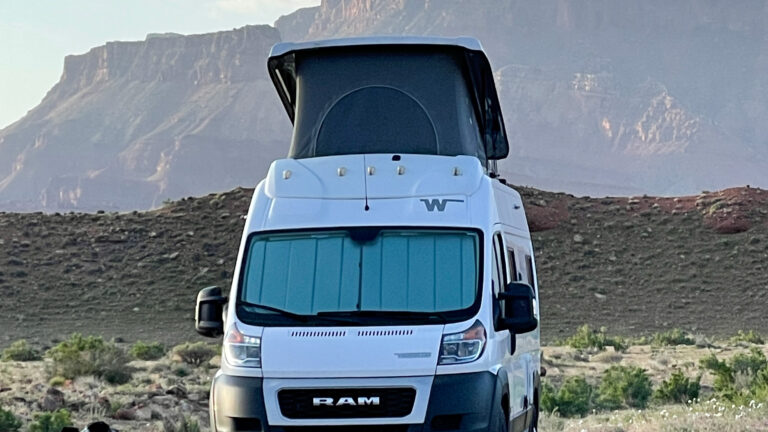
Class B camper vans give you the most flexibility. They’ll fit at every South Rim campground, handle tight parking lots, and can take any of the three routes to the park comfortably.
Travel trailers work well if you want to set up a base camp and explore. Book a site in Flagstaff, Williams, or Trailer Village, unhitch, and use your tow vehicle for day trips. Take the Williams route, and make sure your trailer is 30 feet or less if you want to camp at Mather.
Class A motorhomes offer the most space and comfort, but you’ll need to plan around their size. Take I-40 to Williams, and book Trailer Village or an RV park in Williams or Flagstaff. Leave the RV in Williams and ride the train, or drive into the park, use designated RV parking, and explore by free park shuttle.
Cost breakdown: Flagstaff to Grand Canyon by RV
| Expense | Estimated Cost |
| RV rental | About $179 per night for a Class C, $149 for a Class B, and $185 for a Class A on average (Flagstaff area) |
| Fuel (~160–180-mile round trip) | ~$75–$105 for a gas motorhome at 8–10 mpg (Arizona regular averaged about $4.70/gal in late September 2026; diesel costs more) |
| Park entrance | $35 per private vehicle, good for 7 days. Non-U.S. residents 16+ pay an additional $100 per person unless they hold a qualifying annual pass. |
| Trailer Village (full hookups) | About $80–$85 per night |
| Mather Campground (no hookups) | $30 per night ($15 with a Senior or Access Pass) |
| Grand Canyon Railway RV Park, Williams | From about $64–$72 per night in peak season (April–October), plus tax |
| Grand Canyon Railway (optional) | About $70–$243 per person round trip, depending on class |
| Hotel + rental car comparison | About $150–$225 per night for a South Rim or Tusayan hotel, plus $65–$80 per day for a rental car |
The savings add up if you stay more than a night or two. Cooking your own meals also means you don’t need to eat at pricey park restaurants.
Key Takeaways
- Flagstaff to the Grand Canyon South Rim is about 80 miles and 1.5 hours on US-180, or about 90 miles via Williams.
- Flagstaff is the best stock-up base, with an airport, groceries, fuel, propane, and dump stations.
- US-180 is the shortest route, but it’s a two-lane mountain road that gets snow and ice November through March.
- I-40 West to Williams, then AZ-64, is the trailer-friendly route and the best winter choice.
- The Grand Canyon Railway from Williams lets you leave the rig parked and ride to the rim.
- Trailer Village is the only in-park campground with full hookups. Mather has no hookups, plus it has a 30-foot limit.
Frequently Asked Questions About a Flagstaff to Grand Canyon Road Trip
Flagstaff is about 80 miles from the Grand Canyon’s South Rim via US-180, a drive of roughly 1.5 hours. The I-40 and Williams route is about 90 miles, and the East Entrance route via Cameron is about 105 miles.
Yes, you can do Flagstaff to the Grand Canyon as a day trip. The round trip is about three hours of driving, which leaves plenty of time at the rim. In an RV, though, it’s more rewarding to camp at least one night nearby so you can watch the sunset and sunrise over the canyon.
I-40 West to Williams, then AZ-64 North, is the best route for an RV or travel trailer. It’s only about 10 miles longer than US-180, with interstate driving for the first 30 miles and straighter, gentler grades on AZ-64.
US-180 stays open in winter, but snow and ice can close sections north of Flagstaff, and storms often bring traffic backups near the Arizona Snowbowl turnoff. From November through March, RVers should take I-40 to Williams and AZ-64 instead.
There’s no train from Flagstaff to the Grand Canyon, but the Grand Canyon Railway runs daily from Williams, about 30 miles west. The 65-mile ride takes 2 hours and 15 minutes each way and drops you about 200 yards from the rim. Many RVers park at the Grand Canyon Railway RV Park and ride in.
Yes, there are full-hookup RV sites inside Grand Canyon National Park, but only at Trailer Village RV Park in Grand Canyon Village. It has water, sewer, and 30- and 50-amp electric, with pull-through sites for rigs up to 50 feet. Book well ahead, since spring through fall dates fill up quickly.
Plan your Flagstaff-to-Grand-Canyon RV trip
Ready to plan your trip? Browse RV rentals in Flagstaff, stock up in town, and be at the rim of the canyon by lunchtime.