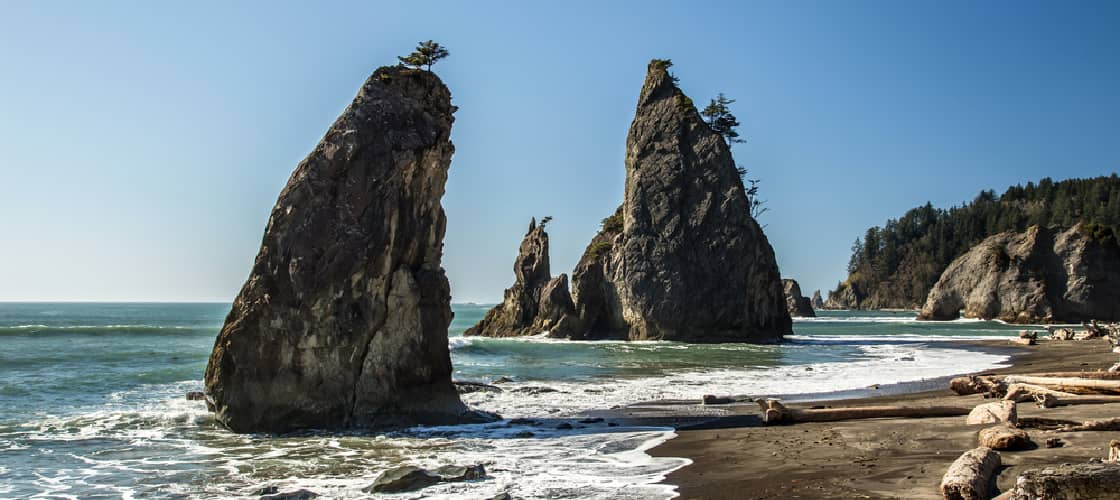
Olympic National Park covers almost a million acres. It also covers a variety of ecosystems including glacier-covered mountains, seashores, temperate rainforests, and lowland forests. Visitors to the park can spend a day at the beach, walk through one of the wettest places in the continental U.S., or enjoy mountain peaks further inland. But Olympic National Park is also one of the most visited national parks in the United States.
It can be hard to appreciate some of the park’s natural beauty when you’re waiting in lines to park or fighting for space at an overlook. Fortunately, there are several destination dupes in the Pacific Northwest. These Olympic National Park alternatives give you the same feel as the park, but with fewer crowds and often lower prices.
This article will share places with fewer tourists, lower prices, more opportunities for pets, more options for families, and places full of outdoor adventures for nature lovers and thrill seekers. We’ll also cover the best alternatives to Olympic National Park that are nearby, easy to RV to, and which offer the most similar landscapes.
These eight destination dupes are great alternatives to Olympic National Park.
The 8 Best Alternatives to Olympic National Park: At a Glance
| Alternative | Best For | Most Like Olympic National Park Because | The Big Tradeoff | RV Home Base |
| Cascade Head Preserve, OR | Crowd-free | Pacific coastal views, 350 species of wildlife | Much smaller scope; less diversity in landscape (no rainforest or alpine mountains) | Newport or Lincoln City, OR |
| Umpqua National Forest, OR | Budget-friendly | Old-growth forests, waterfalls, volcanic mountains and abundant rivers | No oceanfront scenery; more green mountainous landscape | Dispersed camping within the forest itself or developed private campgrounds in nearby communities like Roseburg |
| Mount Hood National Forest, OR | Pet-friendly | Alpine lakes, snow-capped mountain, waterfalls | No coastal views; single mountain (Mt. Hood) dominates the landscape | Dispersed camping in the national forest itself or developed, private campgrounds in the greater Portland area |
| Moran State Park, WA | Family-friendly | Forested mountains, lakes, and Pacific Northwest Island scenery creates a miniature Olympic Peninsula experience | Far smaller; no Pacific coastline within the park itself and less wilderness | Dry camping available within the park; limited RV camping on the rest of the island |
| North Cascades National Park, WA | Rugged outdoor adventure | Glaciated peaks, alpine lakes, dense forests and wild backcountry | No coastal views; more firmly alpine | Limited dry camping within the national park itself; resort-style, private campgrounds in nearby Marblemount and the wider Seattle area |
| Olympic National Forest, WA | Nearby | Literally encompasses the same wilderness as Olympic National Park; close enough to day-trip into the national park | Less concentrated, iconic “park” feel, and lower-altitude mountains | Dispersed camping within the forest itself; select private campgrounds on the peninsula and resort-style campgrounds in the wider Seattle area |
| Cape Disappointment State Park WA | Easy RVing | Temperate rainforest, foggy Pacific coastline, dunes, rivers and lush forests | Lower-elevation, coastal environment; no alpine mountains | 60 full-hookup sites available in the park itself; other nearby campgrounds and small towns with resources |
| Siuslaw National Forest, OR | Similar landscape | Dramatic coastal scenery, cliffs, beaches and forested coastline | No alpine mountains; no nearby temperate rainforest | Limited electric hookup sites available at Sutton Campground and Tillicum Beach Campground |
Crowd-Free Alternative: Cascade Head Preserve, OR
Cascade Head Preserve is along the central Oregon coast and includes forests, headlands, and the Salmon River estuary. It’s a UNESCO Biosphere Reserve, and more than 350 species of wildlife – including several endangered species – live at the preserve.
You can enjoy scenic hikes along the coast and support the conservation efforts of the preserve at the same time. Nature lovers can take in views of the Pacific Ocean and the Salmon River Estuary. There are also meadows filled with wildflowers that attract butterflies and songbirds. You’ll also get to explore nearby Oregon coast communities like Pacific City, Lincoln City, and Newport, famous for their endless views, ample seafood options, and fun coastal to-dos.
Best Time to Visit
The best time to visit Cascade Head Preserve is in spring and early summer. Wildflowers are in bloom and the weather is pleasant. Fall is another nice option, especially considering some areas close in the winter to protect the wildlife.
Ideal trip length
- Long weekend (three to four days)
Closest RV-friendly gateway
- If you want to camp near the preserve, you can look in towns like Pacific City, Lincoln City, and Newport.
Pet restrictions
- Because this is a delicate preserve, pets are not allowed on the trails, so leave dogs at home (The Nature Conservancy)
Signature hike or experience
The Tradeoff
- Much smaller scope; less diversity in landscape (no rainforest or alpine mountains)
How to Access
The preserve is accessible via Highway 101, so it’s an easy drive to the area. There is plenty of parking at trailheads, and there are no fees to visit the area. If you want to fly into the area, you can land at the Eugene Airport and rent an RV to drive to the coast.
Why It’s a Great Alternative
- features lush coastal forests, dramatic ocean views, and diverse wildlife
- there are significantly fewer visitors compared to Olympic National Park
- offers excellent hiking opportunities with the congestion of popular Olympic trails
Selection Methodology
- compared visitor data from the National Park Service – Olympic National Park attracts more than 3 million visitors each year, making some areas very crowded. Cascade Head Preserve provides a comparable coastal rainforest experience with fewer tourists and serene landscapes
- analyzed traveler reviews that emphasized solitude and minimal foot traffic
Budget-Friendly Alternative: Umpqua National Forest, OR
Umpqua National Forest is in a rather remote region of Southern Oregon along the northwest border of Crater Lake National Park in the Cascade Range. The forest is blanketed with trees and has numerous waterfalls and lakes as well. The Umpqua River runs through the forest from the Oregon Coast Range to the Pacific Ocean. Although you need a Northwest Forest Pass at many day-use sites and trailheads, it’s a fraction of the entrance fee for Olympic. You can also find inexpensive, or free, camping in the forest.
Hike to Toketee Falls, where you can see the waterfall gorge which is covered in basalt columns. The hike is considered an easy one, with a 0.8-mile out-and-back trail. The falls are also a popular destination for photographers.
Best Time to Visit
The best time to visit the forest is from late May through early fall. The snow is melted and the weather is pleasant for hiking, camping, and walking to the many waterfalls in the area. You can also visit in winter for skiing and snowshoeing.
Ideal trip length
- Long weekend to one week (three to five days)
Closest RV-friendly gateway
- There is dispersed camping in the national forest. You can also look for campgrounds in Roseburg, or in towns like Sutherlin, Canyonville, or Winston. These are also good places to pick up supplies or treat yourself to a meal at a local restaurant.
Pet restrictions
- Dogs are welcome on all trails as well as in picnic areas and campgrounds, though leash laws apply (U.S. Forest Service)
Signature hike or experience
- Soaking in Umpqua Hot Springs
The Tradeoff
- No oceanfront scenery; more green mountainous landscape
How to Access
You can get to the forest from main highways including OR-138 and OR-58, although smaller forest roads lead to more remote areas of the forest. Those smaller roads can be hard for RVs to navigate, however. You may want to set up camp and use a tow vehicle to explore the narrower, smaller roads.
Why It’s a Great Alternative
- Umpqua National Forest has waterfalls, old-growth forests, and hot springs – all similar features to those at Olympic National Park
- the forest doesn’t have expensive national park entry fees, just a nominal fee for the forest pass
- there are also more affordable camping and lodging options in and near the forest
Selection Methodology
- researched entrance fees for both destinations, along with accommodation costs and travel expenses. Olympic’s entrance fees and other costs can add up, while the national forest offers a similar Pacific Northwest feel for a lower cost.
- evaluated the accessibility for budget travelers – how close each destination was to major cities, and how easy it was to reach on a road trip
- compared the two landscapes for aesthetic and geological similarities
Pet-Friendly Alternative: Mount Hood National Forest, OR
Mount Hood National Forest includes Mount Hood itself – the iconic mountain volcano that looms in the background of Portland views. The forest is home to alpine lakes, ski resorts, and a portion of the Oregon Trail (take care not to die of dysentery).
The 1930s-era Timberline Lodge at Mt. Hood is an iconic hotel. The rustic-feeling lodge is even movie-famous since it was used for exterior shots of the Overlook Hotel in “The Shining.” You can ski at the resort here, spend the night, or pop in for a meal or drink to experience the beautiful lodge.
In summer, you can hike more than a thousand miles of trails including parts of the Pacific Crest Trail. You can also go mountain biking, boating, rafting, and fishing. Finally, take the Mount Hood Scenic Loop to get beautiful views of the mountain and the surrounding areas.
The national forest is also pet-friendly. Olympic National Park only allows dogs on a small number of trails and beaches, and they’re not allowed in the backcountry. The national forest allows dogs on almost all trails, and if they’re under voice command they can be off-leash as well.
Best Time to Visit
The best time to visit Mount Hood National Forest depends on what you want to do. In summer, enjoy hiking and warm-weather outdoor activities. Winter brings skiing, snowshoeing, snowboarding, and other winter fun. Late spring brings wildflower blooms while fall is a beautiful time for foliage and to watch the salmon spawn.
Ideal trip length
- Long weekend to one week (three to five days)
Closest RV-friendly gateway
- Dispersed camping is available throughout the national forest, and there are also developed campgrounds in and around nearby Portland
Pet restrictions
- As long as your dog is under control, it’s welcome in Mt. Hood National Forest (U.S. Forest Service)
Signature hike or experience
- Ramona Falls or Barrett Spur; hot chocolate at the Lodge
The Tradeoff
- No coastal views; single mountain (Mt. Hood) dominates the landscape
How to Access
Mount Hood is about 60 miles east of Portland, and it’s easily accessible via Highway 26. There is also a public bus that runs from the city of Sandy to the Timberline Lodge, with stops at other resorts. Winter weather can affect the drive to Mount Hood ski resorts, so it’s a good idea to check forecasts and avoid snowstorms.
If you want to fly into the area, you can land at Portland International Airport and then rent an RV to use on your trip. There are plenty of campgrounds from Portland to Mount Hood as well.
Why It’s a Great Alternative
- allows dogs on most trails and in campgrounds and there are fewer pet restrictions than at Olympic
- features towering forests, alpine lakes, and scenic hiking trails
- there are many pet-friendly accommodations nearby
Selection Methodology
- analyzed national park policies on pet accessibility – Olympic National Park has strict pet restrictions and limits access for dog owners while Mount Hood National Forest offers a comparable outdoor experience with more freedom for pets
- reviewed pet-owner testimonials on the safety and difficulty of hiking trails in the forest
Family-Friendly Alternative: Moran State Park, WA
Moran State Park in Washington is a family-friendly state park on Orcas Island in the Puget Sound. Kids can explore wetlands, lakes, hills, forests, and bogs. Cascade Lake has a beach, a swim area, and plenty of space to play. You can also rent paddle boats, stand-up paddleboards, kayaks, and other small boats. The lake is stocked with rainbow trout which increases the possibility of catching a fish. Kids will also enjoy visiting the salmon hatchery.
The Summit Visitor Center has exhibits on the geology of the San Juan Islands, and families can learn about the islands’ original inhabitants and the history of the area. You can also drive to the top of Mount Constitution – the highest point on the island – and learn about former Seattle mayor Robert Moran. Finally, take the self-guided interpretive trail to learn more about the environment of the park.
After a day of exploring, you can treat everyone to an ice cream sandwich from the Sugar Shack.
Best Time to Visit
Summer is the best time to visit the park with a family, although there are things to do all year round. In summer, you can swim, camp, boat, fish, go horseback riding, and much more. Spring brings wildflowers and is a great time for birdwatching. Fall is a lovely time to visit and see the autumn foliage. Some facilities are limited in winter, and it’s the least popular time to visit. However, you can do some winter activities like snowshoeing in the park.
Ideal trip length
- Long weekend to one week (three to five days)
Closest RV-friendly gateway
- Dry camping is available within the state park itself
Pet restrictions
- The park is pet-friendly, but Washington state law requires all dogs to be on a leash of no more than eight feet in length at all times (Friends of Moran)
Signature hike or experience
- Summiting Mount Constitution, the highest point in the San Juans, or visiting Cascade Falls
The Tradeoff
- Far smaller; no Pacific coastline within the park itself and less wilderness
How to Access
The most common way to get to Orcas Island is by catching the Washington State Ferry from Anacortes. You’ll want to make reservations, especially during the summer months. RVs are allowed on the ferry as well. You’ll definitely want to make a reservation to bring an RV. RVs need to be under 14 feet tall to have proper clearance. Ferry fees are based on vehicle length, so longer RVs may be charged more. Also, during low tide, loading ramps have steeper angles. It may be easier to drive your RV onto the ferry during high tide. Arrive at the ferry early so you have plenty of time to get your RV ready for the boat ride.
Why It’s a Great Alternative
- features lush forests, waterfalls, and accessible trails that are perfect for families
- easier, kid-friendly hikes compared to Olympic’s rugged terrain
- offers opportunities for lake activities like kayaking and paddleboarding
Selection Methodology
- evaluated park accessibility and ease of hiking trails that are suitable for families – Olympic’s vast and remote nature can be overwhelming for families with young children. The state park provides a similarly stunning Pacific Northwest experience with more family-friendly amenities
- reviewed family travel blogs and visitor testimonials about kid-friendly experiences
Outdoor Adventure Alternative: North Cascades National Park, WA
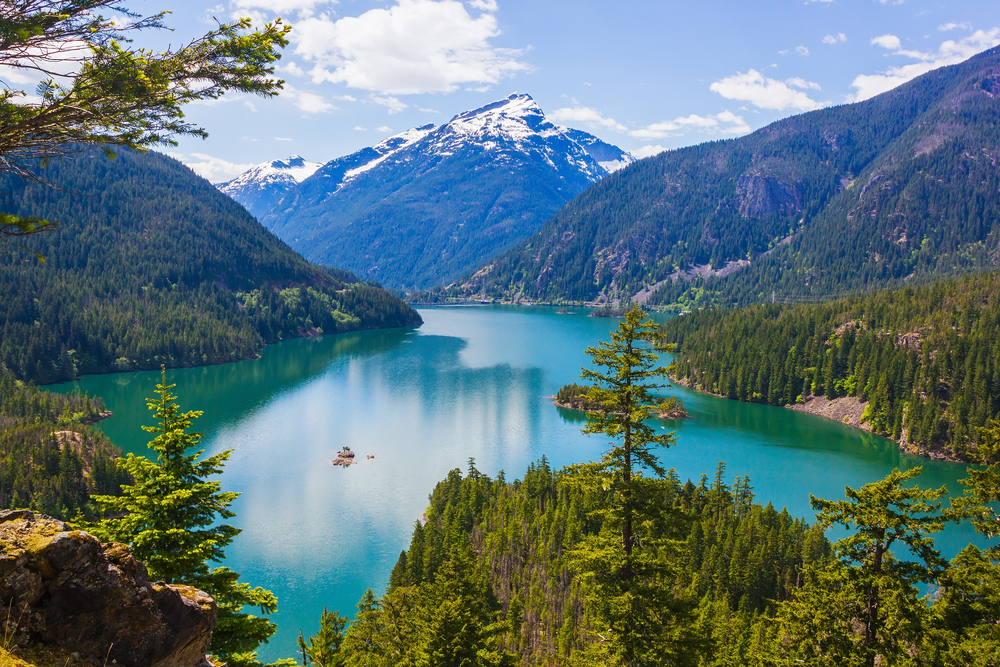
Washington state has both one of the most-visited and one of the least-visited national parks in 2024. Olympic National Park was one of the top choices with 3.7 million visitors, while North Cascades National Park had just 16,485.
One of the reasons that North Cascades is less popular than Olympic is its remote location and the wilderness of the park. The park has fewer amenities, along with more challenging trails and fewer things to see with a short drive or walk. North Cascades also has the highest death rate among visitors in the U.S. with 60 deaths per 1 million visits. Almost half of those are due to falls while hiking or climbing.
You’ll want to arrive at the park prepared for outdoor adventures and with some outdoor experience and training. This isn’t a beginner park. Many of the trails or climbs are in the backcountry, so you’ll want to have some skills to survive in the wilderness just in case. But the pristine wilderness and amazing views while in the park are a great reward for all of your efforts and preparation.
The Sahale Glacier is a popular stop for park visitors, but make sure you get a backcountry permit. The trail to the glacier is an off-shoot of the Cascade Pass Trail – a beautiful day hike in its own right. Backcountry permits can be limited during the popular summer months, so be sure to get one as soon as you know your plans.
While there are lots of advanced hikes in the park, there are some options that are not in the backcountry as well. Drive the North Cascades Highway, stopping at the Diablo Lake Overlook and enjoying the scenery all along the way. Go boating on Ross Lake or Lake Chelan, or enjoy fishing in the lakes or the Skagit River.
Best Time to Visit
The best time to visit North Cascades is from May to September. If you want to do higher elevation or backcountry hikes, aim for late July or August and be prepared even then for lots of snow. The park is closed in winter.
Ideal trip length
- Long weekend to one week (three to five days)
Closest RV-friendly gateway
- Limited RV camping with no hookups is available inside the national park itself; resources and campgrounds also available in nearby Marblemount. There are also lots of campgrounds in Seattle where you can stay and explore Seattle for a few days before heading into the wilderness.
Pet restrictions
- Restrictive: Pets are not allowed in the national park except leashed on the Pacific Crest Trail (National Park Service)
Signature hike or experience
- Rainy Lake Trail or the scenic drive along Highway 20
The Tradeoff
- No coastal views; more firmly alpine
How to Access
You can drive to the park via the North Cascades Scenic Highway (WA-20), which connects with I-5 in the west and U.S. Route 97 to the east. The highway is closed during the winter. If you want to fly to the area, land at the Seattle-Tacoma International Airport or Vancouver International Airport – both are about 130 miles from the park. You can rent an RV in either of those cities to drive to the park. There are lots of campgrounds in Seattle where you can stay and explore Seattle for a few days before heading into the wilderness.
Why It’s a Great Alternative
- features towering peaks, alpine lakes, and glacial valleys
- offers exceptional hiking, backpacking, and mountaineering for outdoor lovers
- has significantly fewer crowds compared to Olympic National Park’s popular destinations
Selection Methodology
- evaluated the activities offered at the park beyond sightseeing
- analyzed reviews from outdoor enthusiasts. who were seeking intense experiences
- looked at Olympic’s adventure spots, which are often crowded – especially in peak season. North Cascades provides a similarly thrilling outdoor experience with more solitude.
Nearby Alternative: Olympic National Forest, WA
The difference between Olympic National Forest and Olympic National Park? Along with who manages it (the U.S. Forest Service vs. the National Park Service), it’s also about what the land can be used for. In other words, it’s all basically red tape and logistics: the landscape these two wildernesses preserve is literally the same, with Olympic National Forest tucked just south of the national park.
While it’s true that some of the most splendorific sights on the Olympic Peninsula fall within the national park’s boundaries, it’s also true that Olympic National Forest has a lot to offer, including lush old-growth forests, stunning waterways, endless miles of green-tunnel hiking trails and diverse flora and fauna. It’s also often far less crowded than its neighbor to the north, and far more dog-friendly. If you’re looking for a dupe that’s close enough to allow you to day-trip in the real thing, Olympic National Forest is the place to be.
Best Time to Visit
Much like Olympic National Park itself, the national forest is usually best experienced during the summer months from July to October, when the Pacific Northwest as a whole experiences its dry season. But if you’re feeling adventurous and have the right gear, visiting in spring or fall can unlock high-powered waterfalls, wildflowers, and even fewer crowds. Plus, when you travel by RV, you’ll have a nice warm camping spot to return to!
How to Access
The nearest airport is, again, Sea-Tac, and you could rent an RV and drive it out to Olympic National Forest from there. Many RVers will find it makes the most sense to drive south around the Puget Sound along I-5 and then WA-16, before ending up on WA-3 and then WA-104 over the Hood Canal Floating Bridge.
Ideal trip length
- Long weekend to one week (three to seven days)
Closest RV-friendly gateway
- Again, Seattle is a good starting place, but there’s plenty of dispersed camping available within the national forest and select private campgrounds with hookups on the peninsula
Pet restrictions
- Pets must be under voice control or on a leash, but are welcome in the national forest (U.S. Forest Service)
Signature hike or experience
The Tradeoff
- Less concentrated, iconic “park” feel, and lower-altitude mountains
Why It’s a Great Alternative
- literally encompasses the same overall wilderness
- close enough to the national park to allow you to day-trip in while taking advantage of quieter, less-crowded environs in the national forest at night
Selection Methodology
- considered wilderness areas closest to Olympic National Park
- compared specific landscape and environmental features
- reviewed pet policy and various landscape uses
Easy RVing Alternative: Cape Disappointment State Park WA
Don’t let the name fool you: Cape Disappointment State Park is anything but disappointing, especially for RVers. Unlike many of the other alternatives offered here, this park has 60 full-hookup sites right on campus, making it an easy destination that allows you to stay comfortably and conveniently just at the heart of all its action.
But the well-appointed on-site campground is just the beginning. The point, after all, is what you’ll get to experience when you’re not relaxing in your RV. Cape Disappointment offers soaring coastal views, the opportunity to tour a lighthouse, and to learn more about the treacherous and historic Columbia River Bar, one of the most dangerous water crossings in the entire world. Of course, it looks peaceful from high above, where you’ll be viewing it, after wandering the sands of dramatic Pacific shorelines or hiking in dense, fern-covered trails.
Psst: Wondering why it’s called Cape Disappointment? Back in the day, when European explorers were trying to find the mouth of the Columbia River, they weren’t having much luck — and as mentioned, for those on the boats, this part of the world was a hum-dinger of a dangerous time. That’s why so many of the nearby landmarks, like DIsmal Nitch and Dead Man’s Cove, have grim names in the midst of such an obviously stunning backdrop.
Best Time to Visit
Again, many visitors will be happiest visiting this coastline between July and early October. But keep your eye on the weather, because there are sunny days now and then during the otherwise rainy season.
How to Access
Cape Disappointment is tucked back along Highway 101, and easily accessible from either Portland or Seattle if you’re flying in and renting an RV on-site. If you’re coming from the south and passing through Astoria, do be prepared to drive over the iconic, high-flying (and, for some drivers, somewhat intimidating) Astoria-Megler Bridge.
Ideal trip length
- Long weekend (two to three days)
Closest RV-friendly gateway
- The park itself offers excellent campsites, and there are also other RV camping options in the area. Astoria is the closest town with major resources including medical care and groceries.
Pet restrictions
- Dogs are allowed so long as they are leashed (Washington State Parks)
Signature hike or experience
The Tradeoff
- Lower-elevation, coastal environment; no alpine mountains
Why It’s a Great Alternative
- temperate rainforest, foggy Pacific coastline, dunes, rivers and lush forests emulate many best-loved Olympic National Park features
- ease of access from major Pacific Northwest cities
Selection Methodology
- evaluated landscape similarity and available recreational opportunities
- took RV-specific resources into account
- compared campground features with others in similar landscapes
Alternative with the Most Similar Landscape: Siuslaw National Forest, OR
Although it’s far enough south along the Pacific Coast to be in an entirely different state, Siuslaw National Forest might just surprise you with exactly how similar to Olympic National Park it is. Home to some of the most dramatic features along the Oregon Coast, with names like Devils Churn and Thor’s Well, you’ll feel you’ve entered a mystical universe, with moss-covered trees, sunlight glinting through the evergreens, and the never-ending crashes of the tempestuous ocean along the ancient, craggy coast.
While it’s missing access to alpine mountains, Siuslaw National Forest captures the coastal side of Olympic NP like no other landscape in the area, and indeed is a world-class destination all its own. Save time to visit the nearby town of Yachats, considered by many locals to be one of the sweetest along the entire coastline — or take a day trip up to Newport to visit the famous Oregon Coast Aquarium.
Best Time to Visit
The Oregon Coast can be finicky with its weather truly any time of year, though aiming for the summer months will give you the best chance of sunny days. (You should still bring your coziest flannel and some other warm layers, however.)
How to Access
Follow Highway 101 south after cutting your way west from Portland along Route 26 — or Route 22 from Salem.
Ideal trip length
- Long weekend (three to five days)
Closest RV-friendly gateway
- The town of Newport has the most robust resources in the area, though there are various camping options around the national forest itself — including limited hookup sites at Sutton Campground and Tillicum Beach Campground
Pet restrictions
- Dogs are generally allowed throughout the national forest, but must be leashed. Additionally, some beach areas are closed to dogs to protect nesting Western Snowy Plovers from March 15 through September 15 (U.S. Forest Service)
Signature hike or experience
The Tradeoff
- No alpine mountains; no nearby temperate rainforest
Why It’s a Great Alternative
- dramatic coastal scenery and geological features offers a very similar vibe to Olympic National Park coast
- multiple hiking opportunities and a visitor center to help get oriented; closer to the “park” experience
Selection Methodology
- considered multiple Pacific Northwest coastal wildernesses for similarities and differences
- evaluated available recreational opportunities
- took RV-specific resources and ease of access into consideration
Olympic National Park is a beautiful area for outdoor activities and admiring the Olympic Mountains. But the park can get crowded and it can be hard to appreciate the beauty of the area when it’s teeming with people. Fortunately, there are several Olympic National Park alternatives you can try that give you the same feel as Olympic without the crowds.
If you want suggestions for other destination dupes for popular national parks and attractions, check out our full list!