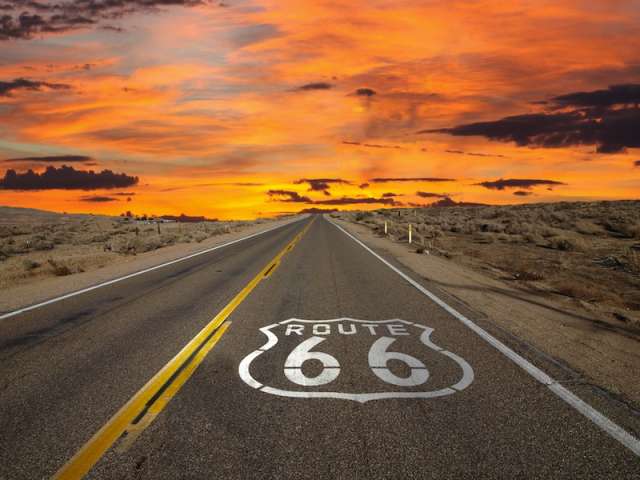
Route 66 a.k.a. The Mother Road. This 2,500-mile highway stretches from Chicago, Illinois to L.A. in California. Although it first opened in 1926, making 2026 its 100-year birthday, this road that rewrote the story of the American Road Trip first became a popular summer trip option in the late 1940s and early 1950s, though it ceased to be considered an official road by 1985. (Still, it remained a popular attraction, even as newer, more contemporary highways came in to replace parts of the Historic Mother Road.)
In this post, we’ll walk you through some Route 66 history, naming some iconic stops along Route 66 and also exploring how it’s changed over time. And, yes, you can still follow in the footsteps of historic American travelers and hit this road today. We’ve got all the details you need to do so in style.
Although sections of the road are no longer intact, many of the sites, scenes, and curiosities that had made their homes along the stretch still exist. Drive through naturally existing rock formations in Arizona, and visit the Route 66 Drive-in Theater in Carthage, Missouri. If you find yourself itching for an unforgettable RV road trip, share this with your favorite driving companions and head to Route 66.
How Route 66 Changed and Why Some Sections Were Abandoned
Route 66 began as an idea meant to foster economic growth, connect disparate parts of the country, and create an easy way to drive from rural areas in the midwest all the way to the Pacific. As driving cars became more commonplace and the U.S. began modernizing its highway system, however, parts of the historic highway were paved over with bigger roadways (including portions of modern interstates like I-55, I-44, I-40, I-15, and I-10).
Unlike the original Mother Road, which was all about wandering from one rural community to another, contemporary interstates are about speed and efficiency. The point is to get where you’re going, and fast, which often meant bypassing towns entirely. As traffic shifted to these new highways, many segments of Route 66 lost their economic purpose. Businesses closed, populations dwindled, and some stretches fell into disrepair. By 1985, Route 66 was officially decommissioned. But the abandoned sections gained a new meaning under this new context. They became historical artifacts, preserving a snapshot of mid-20th-century American life and reminding travelers of an earlier, more meandering way of moving through the country.
The Natural Wonders of Route 66
On your way through, check out the enormous and impressive Meteor Crater, also found in Arizona. In New Mexico, you can go for a swim in the Blue Hole of Santa Rosa. Visiting these rare sites tends to put time, space, and everything else in perspective.
The Ghost Towns of Route 66
When traveling through the Wild West consider stopping by one of the several ghost towns found on Route 66. Some, such as Oatman, Arizona have staged gunfights, wild donkeys wandering the streets, and gift shops. The locals consider it a “living” ghost town.
There are other less active options with a range of levels of preservation. Calico, California, for example, is maintained by a park system and has a campground, which allows guests to explore the haunt for days–and nights–at a time. More rustic choices include Amboy, California; Anaconda, New Mexico; Hackberry, Arizona; Hext, Oklahoma; and Clementine, Missouri to name a few. With a little research, you could visit a couple of ghost towns in each state you cross.
The Curiosities of Route 66
Due to the constant stream of new tourists passing through on the Route, many roadside attractions cropped up over the years. From viewing “the World’s Biggest” to buying “the World’s Strangest,” for those who like oddities, there is nowhere better.
Some of the highlights on the drive include the World’s Biggest Bottle of Ketchup and Cadillac Ranch in Amarillo Texas, where–with a can of spray paint–you can contribute to the installment piece.
Stay in a tee pee shaped motel room at one of several Wigwam Villages. Then shop for curios at Tee Pee Curios in Tucumcari, New Mexico where the whole town of Tucumcari appears to be frozen in time. This way you can have a memento to remember your time on the road.
The Eateries of Route 66
When people think of Route 66, many anticipate drive-ins and greasy, finger-licking burgers. In fact, there are many great places to eat on the route. This is especially true if you like classic American cuisine, but there is a wide variety to choose from.
While cooking for yourself is one of the best parts of RV traveling (and can help reduce the overall cost of traveling a ton), many of these eateries are still up and running and worth stopping in for the iconic Route 66 experience.
For example, you can get some fried chicken and home cooking at Dell Rhea’s Chicken Basket, which has been in business since 1946. In New Mexico, you can get the green-chili burger at the Badlands Burgers, which was previously called the “Uranium Café.” Check out Oklahoma and Texas for fantastic barbecue; both states are renowned for their meats. Then cool off at an Old West style saloon like Roadkill Cafe & OK Saloon. You have plenty of eateries to choose from on this road trip.
Most Iconic Sections of Route 66 Today
While you can drive the entirety of the historic Route 66 corridor (especially if you’re traveling in a one-way RV rental, which saves you time on the return trip), even seeing a few smaller segments of the Mother Road can make for an unforgettable jouruney. Here are some of the most iconic ones to consider today.
- The Heartland Stretch: From its official start in Chicago to the Gateway to the West that is St. Louis, this section preserves the feel of Route 66 as a working road, passing through farmland, small towns, and two-lane highways that closely follow the original alignment. Many stretches remain intact and clearly marked, offering a strong sense of how early motorists experienced cross-country travel.
- Oklahoma’s Longest Continuous Segment: Fun fact: Oklahoma contains more drivable historic Route 66 roadway than any other state. Its extended, uninterrupted sections showcase open skies, unending plains views and classic midcentury roadway design, reflecting how the route functioned as a vital east–west corridor.
- The Texas Panhandle: Short but memorable, the Texas Panhandle marks the transition of Route 66 into the desert southwest. Experience the rural nature of the original roadway, as well as iconic highway stops like Cadillac Ranch.
- The Deserts and Mountains of Northern Arizona: Running directly through Winslow, Arizona (of Standin’-on-the-Corner fame) before taking you to Flagstaff, the gateway to Grand Canyon National Park, this section of historic Route 66 is often considered the most scenic. Empty high-desert landscapes are punctuated by impressive pine forests, and plenty of smaller communities that maintain the original timeless Route 66 feel.
- The Expanses of California’s Mojave Desert: Evocative, isolated, yet close to one of the biggest population areas in the entire U.S., the southern California desert makes you feel like an original traveler weathering one of the hardest yet most rewarding parts of this road: the home stretch. It’s also not far from once-in-a-lifetime destinations like Joshua Tree and Death Valley national parks.
Although the glory days of Route 66 may be in the past, it still provides old-school Americana. From the majestic scenery to the kitschy shops of oddities, from the ghost towns to the notoriously delicious burger joints, it’s like traveling back in time.
There is no better time to plan your RV road trip along Route 66 than during its 100th year! Enjoy festivals and fun all year long along this iconic road.